Garner
Valley NEES/IRIS/USGS/SCEC/MAEC/CENS/HPWREN/LANL Pilot Project
A workshop held in Austin, Texas, on April 29-30, 2004, launched a new
era in earthquake science and engineering. The Incorporated
Research Institutions for Seismology (IRIS) sponsored the workshop to
discuss the collaborative use of major research facilities to solve
challenging scientific and engineering problems related to Earth
science and seismic hazards. These facilities included those of IRIS
and the Network for Earthquake Engineering Simulation (NEES), both
supported by the National Science Foundation (NSF), and the USGS
National Earthquake Program (NEP). The collaborations discussed at the
workshop have already turned into reality. With the added
participation of the NSF-supported Mid-America Earthquake Center
(MAEC), Southern California Earthquake Center (SCEC), Center for
Embedded Network Sensing (CENS), and High Performance Wireless Research
and Education Network (HPWREN), and the Los Alamos National Laboratory
(LANL), a pilot field experiment was conducted to demonstrate
(successfully!) the potential of such collaborative science.
The original plan for the demonstration experiment at the GVDA was to
showcase NEES mobile shakers, a specially constructed and monitored
structure and its surroundings, and a new experimental approach in
which the simulation of real-time data feeds backs immediately to the
experiment. We expanded on this, adding four new studies. The USGS
provided the core funding for these with additional resources from
IRIS, NEES, USGS, MAEC, SCEC, CENS, HPWREN and LANL. The timeliness of
our endeavor was demonstrated by the fact that the experiment was
planned in less than four months, and the deployment and data
collection carried out in only two weeks – despite the diversity of
participants and instrumentation, and the newness of the technologies
employed. These new studies include the following:
- Non-linear sediment response. We employed the artificial
shaker truck (called T-Rex) and a temporary surface accelerometer
micro-array and permanent GVDA down-hole accelerometers to try to
induce and measure (in 3-D, and for strains and displacements)
nonlinear soil behavior as evident in the change in resonance frequency
with shaking amplitude. If nonlinearity softening occurred we collected
data that will show whether the slow recovery process seen in the lab
occurs in situ.
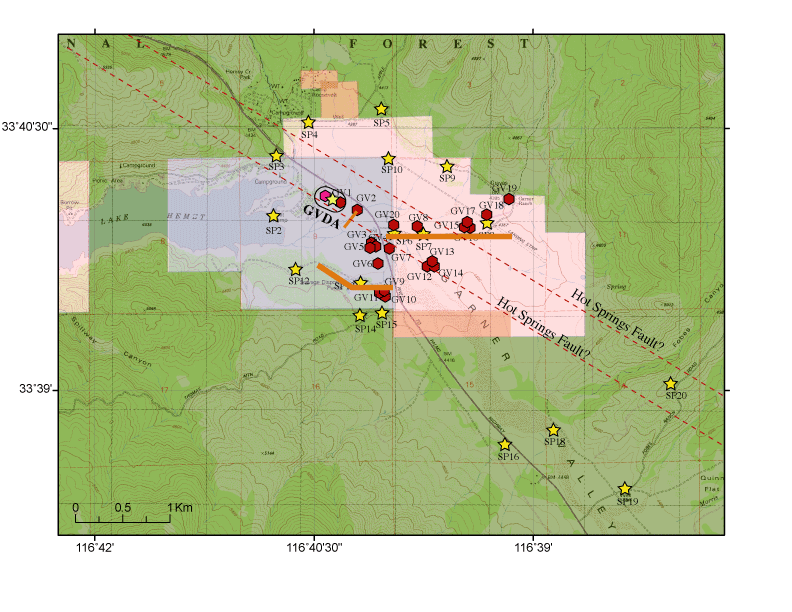
- Ground motion site and basin effects. The relatively small scale
of the Garner Valley basin (~4 km by 10 km, sediment depths <~25 m)
makes its characterization feasible, but scalable to larger basins
elsewhere. We recorded T-Rex signals at 20 temporary real-time,
telemetered seismic stations deployed from the center to the edge of
the basin. This array will be left in place long enough to record
earthquake signals, to validate extrapolating results from the
artificial, surface source to those from natural earthquakes.
- Basin and fault imaging. In addition to using the above array
data for broad-scale shear and compressional wave tomographic imaging
of basin structure, we will construct a high-resolution image along a
profile across the basin, using reflection data generated by T-Rex and
densely spaced geophone strings. Additionally, we hope to locate
the Hot Springs fault that is presumed buried beneath the sediments,
and augmented the T-Rex data with those from a sledge-hammer source and
denser geophone strings.
- Broad-scale, deep imaging. The GVDA sits within the permanent
regional ANZA network and the statewide California Integrated Seismic
Network. Data from these networks will enable us to assess the
distances to which signals from an artificial source like T-Rex may be
observed, as we stack and analyze ‘chirps’ emitted repeatedly every 22
seconds from T-Rex for nearly an hour.
The Austin workshop was motivated by the belief in the adage “the whole
is greater than the sum of the parts” – that when used together
problems can be solved that would otherwise remain intractable.
Workshop discussions and the ideas it generated suggest this indeed is
true, and the field portion of the pilot experiment just completed
certainly begins to prove it.
Photos of the experiment (download them if you like!) were taken by Zack Lawrence, Jack Odum, Paul Hubbard, and Igor Stubailo.